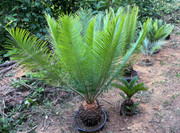
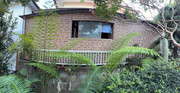
That said, some plants are thriving with all the heat, notably most of the cycads. Cycads LOVE heat, the more the better as far as I can tell. Most of mine have grown their flush of fronds for the year. Sadly I can only get one flush a year for virtually all of them except Ceratozamia robusta which oddly will often throw a few fronds in the late fall/early winter. Currently my Cycas debaoensis are in full growth. The others are about finished. Here's a sample of what's going on in the garden now.
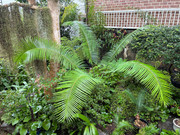
Lepidozamia peroffskyana always flushes for me every May. Here it is a few weeks ago after an afternoon rain. These fronds are really big, up to 2 meters long. They can get longer. One nice thing about this species is it DOESN'T have any spines, so it is a "friendly" garden plant. Most cycads are really spiny things, and I can't tell you how many times I've been scratched, scraped and sometimes wounded by my collection.
A relatively dwarf species is the North American Zamia floridana, the famous coontie. I've seen large populations of these in north Florida where winter temperatures can be down to -7 C or less at times, so I thought they would be fairly cold tolerant here. I left it out one winter and every frond was gone by spring! So now it comes in for the winter. Here it is with a new flush of fronds. Not a beauty, but a cutie.
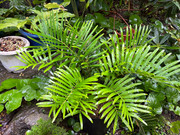
A radically different Zamia species is Z. pseudoparasitica, the only epiphytic cycad in the world. I have two plants that were grown from seed. They are slowly becoming adult plants. These too can have big fronds, perhaps up to 3 meters long each. Mine are still young, so their fronds peak out around half that size so far. Really novel species. Native to the mountains of Panama, they are not frost resistant, but they don't mind temperatures down to 10 degrees C.
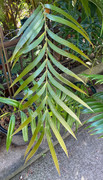
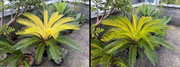
Another North American native is Ceratozamia robusta, a large growing species from southern Mexico and Guatemala. Even though it is native to tropical forests, it is remarkably cold tolerant. It is the only species of cycad I've seen that actually can be in active growth in temperatures below 15 C. It has lovely bronze fronds in early flush, and these eventually turn a dark green. In the picture you can see the same frond in early flush, and again a few weeks later. The frond's are VERY spiny and will rip you to shreds if you're not wary.
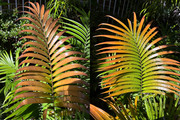
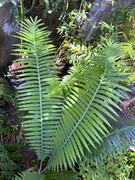
I also grow a few Dioon, all being natives of Mexico. Dioon edule var. edule is the most widespread and well known. I grow two forms, "Palma Sola" and another that I haven't clearly identified. Here it is just after flushing. The leaves are very stiff, almost plastic-like, but are quite lovely in my opinion. They flush with a slight pink tone, which quickly fade to a blue-green.
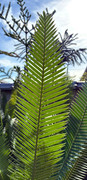
One of the large growing species is D. spinulosum. It can have fronds up to 3 meters at least. I have two mid-sized specimens. This is the smaller one in recent flush. Not frost tolerant, but can handle temperatures below 10 C with no damage.
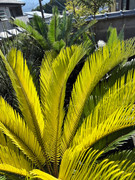
Finally, yes, I mean it, is another look at the lovely yellow flushing form of Cycas revoluta. In the background is Dioon edule "Palma Sola", also recently in flush.
Yes, I am a fool for cycads. Let me know what you think.