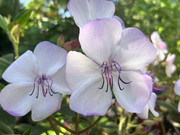
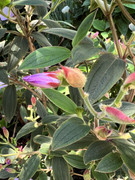
A Nice color form, possibly an interspecific hybrid, definitely not a T. organensis cultivar as listed by growers in California, but not so in New Zealand/Australia where it first appeared for sale. It may be a patented hybrid in New Zealand, a quick Google search alluded to such but didn’t provide more in depth info. The foliage and lack of red fuzzy stems definitely precludes this being T. organensis in my opinion, which I’ve also grown in the past but recently tossed as after 15 years as a container plant, it had greatly lost vigor.
The blooms and foliage look much more similar to T. urvilleana, except it only blooms late summer into autumn here, as compared to T. urvilleana which can bloom year-round in favored mild garden settings here right by the bay or ocean(where wind protected).
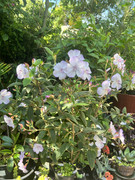
Blue Moon is certainly a very, very attractive and subtle colour variation. You always show us plants David to get the jealosy juices flowing! Mind you, so did Charlie's pic of the picotee Lap Collinge!
Chad, thanks for that info, your computer search skills are better than mine! Did your search turn up additional info on what species were used to create this patented hybrid? It seems closer to Tibouchina urvilleana, and I fail to see any characteristics of Tibouchina organensis. I’m holding off using Pleroma as the revised genus, back to what it was called here in the 1950’s. I just got a Tibouchina granulosa, and was very surprised to see it available. However, I don’t think it likes the temperature range even while still mild; new foliage has not grown larger(at all), in the month I’ve had it, and I suspect it will drop all foliage once we drop below 45°F at night if it’s sulking now with 55°F nights. Probably it much prefers Florida climate than coastal California, but it’s so beautiful where I’ve seen it in Rio/São Paulo that I had to get it. Now I think I need to find someone with a greenhouse to keep it alive through winter.
Aside from sharing a similar petal color(solidly pale lavender rather than a white center for T. organensis, I see absolutely no T. organensis traits with the lack of fuzzy red stems or jewel-like textured foliage characteristic of T. organensis. I had thought plant patents had to include the species hybridized to get patented. Successfully pollinating Tibouchina species is an art form as they are “buzz pollinated” which is something growers in eastern Australia have solved, but seems unknown/unused here in the USA. Those Australian nurserymen are also much better about successfully grafting Proteaceae and Eucalyptus/Corymbia species, something else just not seen here in the states.
Aside from sharing a similar petal color(solidly pale lavender rather than a white center for T. organensis), I see absolutely no T. organensis traits with the lack of fuzzy red stems or jewel-like textured foliage characteristic of T. organensis. I had thought plant patents had to include the species hybridized to get patented. Successfully pollinating Tibouchina species is an art form as they are “buzz pollinated” which is something growers in eastern Australia have solved, but seems unknown/unused here in the USA. Those Australian nurserymen are also much better about successfully grafting Proteaceae and Eucalyptus/Corymbia species, something else just not seen here in the states.
David F wrote: ↑Tue Sep 24, 2024 2:28 am
I had thought plant patents had to include the species hybridized to get patented.
Blue Moon is protected under 'Plant variety rights'. As far as I can see it doesn't have a patent. You'd need a lawyer to tell you what the differences were!
I've never seen this pale one before. On the whole, although you can buy tibouchina from time to time here, they are not something you see in people's front yards at least - I can't think of one I've seen. Maybe it's too dry for them to be left to their own devices long term.