Spring Flowers Alla Nippon
Posted: Sat May 10, 2025 8:38 am
The garden is going off now, the big blast of spring flowers. Soon the heat will build and we will enter the summer monsoon. No more cool mornings, just 24 degrees and rain, rain, rain.
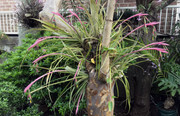
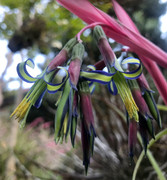
Billbergia nutans seems to be fairly cold tolerant here. It can be grown in the ground, or like this one, epiphytically. We had a long, cold February, but no extreme cold. Nevertheless a few of the growths got a bit frost bit. No matter, it’s recovering quickly.
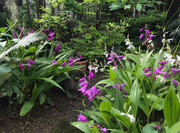
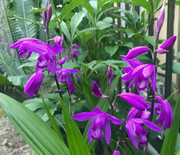
Most of my Bletilla striata collection is in another garden, but I do have a few around the house. This form is of a particularly dark flower type. In fact, the flowers are much darker than this photo would suggest.
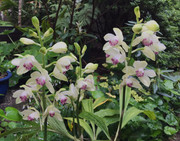
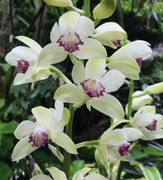
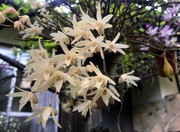
The native epiphytic orchid, Dendrobium moniliforme, is also in flower now. I have several dozen of these with flowers ranging from pure white, to pink and purple. Yellow forms such as this one are likely not pure, but probably contain other Dendrobium species from southern Asia. They all are very cold hardy for epiphytic orchids, easily taking down to -10 C, or even lower.
A shot of a sporling birdnest fern, Asplenium antiquum, another native species. This plant is found mostly in frost free areas of Japan's southern islands, and historically even was found in Fukuoka, though I imagine only in coastal areas away from strong frost events. Nevertheless, I've grown this plant in my garden for 2 decades and it has survived just fine. This little guy is a sporling that showed up near its parent plant several years ago. I put it into the ume tree (Prunus mume) along with a host of other epiphytes. Those little green leaves growing all over are not some odd ivy, but rather are the strange epiphytic vining fern, Lemmaphyllum microphyllum, the green penny fern. All plants in my garden routinely see temperatures below freezing, with the coldest events dipping to -5 C.
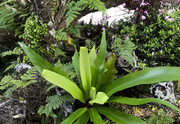
Finally, a plant that cannot withstand winter outside, but is brought in for the winter months, a hybrid "mini-Catt" orchid. These flowers are indeed small, no more than a couple inches wide. They are the result of complex hybridization of the South American genus Cattleya, one of the common "corsage orchids" seen in most flower shops.
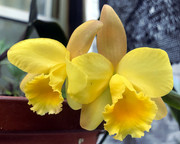
Billbergia nutans seems to be fairly cold tolerant here. It can be grown in the ground, or like this one, epiphytically. We had a long, cold February, but no extreme cold. Nevertheless a few of the growths got a bit frost bit. No matter, it’s recovering quickly.
Most of my Bletilla striata collection is in another garden, but I do have a few around the house. This form is of a particularly dark flower type. In fact, the flowers are much darker than this photo would suggest.
The native epiphytic orchid, Dendrobium moniliforme, is also in flower now. I have several dozen of these with flowers ranging from pure white, to pink and purple. Yellow forms such as this one are likely not pure, but probably contain other Dendrobium species from southern Asia. They all are very cold hardy for epiphytic orchids, easily taking down to -10 C, or even lower.
A shot of a sporling birdnest fern, Asplenium antiquum, another native species. This plant is found mostly in frost free areas of Japan's southern islands, and historically even was found in Fukuoka, though I imagine only in coastal areas away from strong frost events. Nevertheless, I've grown this plant in my garden for 2 decades and it has survived just fine. This little guy is a sporling that showed up near its parent plant several years ago. I put it into the ume tree (Prunus mume) along with a host of other epiphytes. Those little green leaves growing all over are not some odd ivy, but rather are the strange epiphytic vining fern, Lemmaphyllum microphyllum, the green penny fern. All plants in my garden routinely see temperatures below freezing, with the coldest events dipping to -5 C.
Finally, a plant that cannot withstand winter outside, but is brought in for the winter months, a hybrid "mini-Catt" orchid. These flowers are indeed small, no more than a couple inches wide. They are the result of complex hybridization of the South American genus Cattleya, one of the common "corsage orchids" seen in most flower shops.