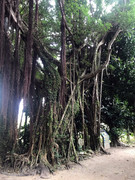
One of the iconic trees of Okinawa is the local banyan species, Ficus microcarpa, found throughout much of SE Asia down to northern Australia. Ficus superba is another banyan found here, but has much less impressive aerial roots by comparison. This is a roadside tree in a traditional style neighborhood, which I’ll talk about later.
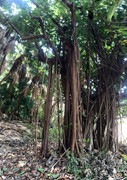
Much less grown is the non-native, Ficus elastica. While most people think of these as relatively small house plants, unrestrained they get to be giants. This one is growing in a city park.
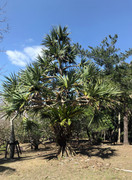
Another commonly seen plant throughout the southern islands of Japan is Pandanus odorifer, a member of the “screw pines”. These are naturally seen along the coastlines and are extremely salt tolerant. Other than the highly serrated rosettes of hanging leaves, the most notable feature are the massive prop roots. The flowers are very fragrant (hence the name), but the large orange fruits and outwardly resemble pineapples are not fit for consumption. This one is growing in a city park. Notice the large Asplenium setoi growing in it’s lower branches.
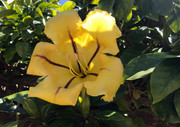
A neat trailing vine-like plant is Solandra maxima. The plant itself can get massive, so it is often pruned to a manageable size. The huge flowers are nearly a foot in diameter and are highly perfumed at night, hence they are bat pollinated. A native of Central America. Despite its lovely appearance, all parts of this plant are highly toxic.
A really cool place to see if you go to Okinawa are the tFukugi tree-lined roads of Bise. Fukugi (Garcinia subellipitca) were used in the past to delineate property boundaries and to protect neighborhoods from the persistent winds and typhoons coming off the adjacent seas. Such places are now basically living museums, and though privately owned, are not the norm in modern Okinawan life. The locals take advantage by marketing to the endless lines of tourists who walk and bike this scenic area. You can even ride an ox drawn carriage through the larger streets.
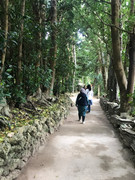
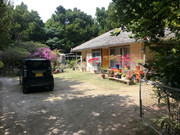
Lot sizes in this area are generous, even by mainland Japan standards. I’d guess most lots, which are always square or rectangular, range between a quarter to half acre, and naturally are lined with Fukugi trees. Now this is a place to retire… if you can stand all the gawking tourists.
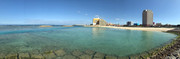
Finally, a shot of the beach next to our hotel. This area is next to an American military base, and there even is an “American town” nearby with steakhouses, taco places and the like. Our hotel is the tall building. Pretty water, and there are tropical fish galore in those waters.